

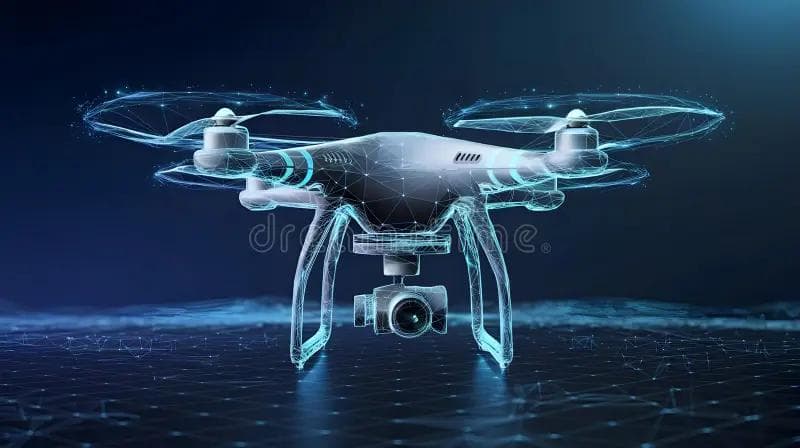
The modern battlespace is no longer defined by overwhelming firepower, but by cognitive superiority at the edge. During the winter solstice testing phase, the Dilaton Engineering Command deployed a six-node autonomous drone swarm into the high-altitude, GPS-denied valleys of the Zanskar range.
The primary objective was to validate our proprietary Inertial Neural Network (INN) under extreme thermal stress and signal jamming conditions.
Phase 1: Deployment & Mesh Initialization
Upon launch from the mobile command vehicle, the six Aegis-Q tactical units immediately established a decentralized local mesh network. Within 4.2 seconds, Unit 01 designated itself as the temporary command node, dynamically sharing spatial odometry data with the remaining five units.
"When traditional satellite uplinks are severed, the swarm must become its own constellation. The Node-6 test proved that our drones don't just survive electronic warfare; they use the localized interference as a variable to strengthen their internal mesh routing." — Dr. Gavakshit, CTO
Environmental Constraints & Telemetry
The operating environment presented multiple asymmetric challenges to the flight controllers. The following parameters were recorded at altitude:
- Ambient Temperature: -18°C
- Crosswind Velocity: 45 km/h with unpredictable thermals
- Electronic Warfare: Active wide-band jamming simulated by ground stations
- Visibility: Less than 10 meters (Heavy localized snowfall)
Phase 2: Target Acquisition & Autonomous Resolution
Despite the zero-visibility conditions, the swarm utilized our localized [Machine Vision] pipeline to identify the thermal signatures of the test assets. The sequence of autonomous resolution occurred as follows:
- Unit 03 detected a thermal anomaly at grid sector 7-Alpha.
- Unit 03 broadcasted the coordinates across the encrypted mesh layer.
- Units 01, 04, and 05 broke formation to triangulate the signature, confirming a 98.4% match to the target profile.
- The swarm autonomously adjusted its loiter pattern to maintain continuous lock without human intervention.

Conclusion and Next Steps
The Node-6 deployment was an unconditional success. The architecture proved that edge-computed swarm logic is highly viable for theater-level deployment. Future iterations will focus on reducing the aerodynamic drag of the optical payloads and optimizing battery thermals for extended endurance.